
You’ve seen it. You walk into a big box store. The sales floor spans the length of a football field. Rows of steel-clad shelves line the halogen-lit bright and flickering aisles. There seemingly exists any item you could ever want. Have a question? Want to know where an item lives in that monstrosity of a store? You look around. Where are the employees? The sales floor stockers? Is there anyone with a uniform, name badge, and a friendly face? Good luck! Once you manage to find an employee to inquire about stock inventory, they consult the store’s website on their phone that says, invariably, sorry, it’s not here, but you can purchase it online and maybe, just maybe, ship to the store for pickup. Which you could have done yourself and saved the hassle of disappointment. What happened to the ubiquitous items like paraffin wax or thread or sales tags, items that only a few years ago were available in any hardware store? Ship to store, baby, ship to store.
It’s no wonder that people don’t want to talk to other people. We’re shuffled into a silo of online platforms for purchases, social interactions, or social-consumer interactions. You either find yourself in a brick-n-mortar store, zombi-fied, wandering the aisles of big box stores with the occasional inventory-scanner/surveillance robot bleeping at you and photographing your movements, or you’re online funneled into an algorithm that feeds you seemingly endless propaganda that may or may not lead directly to a sale, but certainly attempts to persuasively nudge you in that direction. And in all of this, you don’t have to talk to a single person! Many interactions come in the form of artificial intelligence—a chatbot or droningly lifeless AI voice—directing you as to how you can be helped, to stay in the confines of their boxed system. A little Kafka-esque, no?
If it weren’t for the “no service” aspect of this modern drama, we are inundated with a “self service” model, wherein you are tasked with the “job” of performing tasks that were only recently devoted to paid employees; cashiers in these stores were at one time, paid professionals with either a salary and benefits, or at the very least, an hourly wage. Replaced by a system of self-service scanners, customers now have the ease of checking out on their own and the comfort of never having to speak to a human or to make eye-contact. A live-role-play virtual world!
All this goes to say that we’ve been ushered into a new age of tech artificiality and it’s insidiously creeping into everything we do. We’ve been nudged to accept a lack of service by its sheer absence, to the point that we not only expect a lack of service but express a deep skepticism of service. Imagine an employee greeting you at the entrance to a store. What’s your reaction? “Yikes! Don’t talk to me”? Do you jump out of your skin? “No, I can find what I want!” Or do you welcome the personal human-to-human interaction?
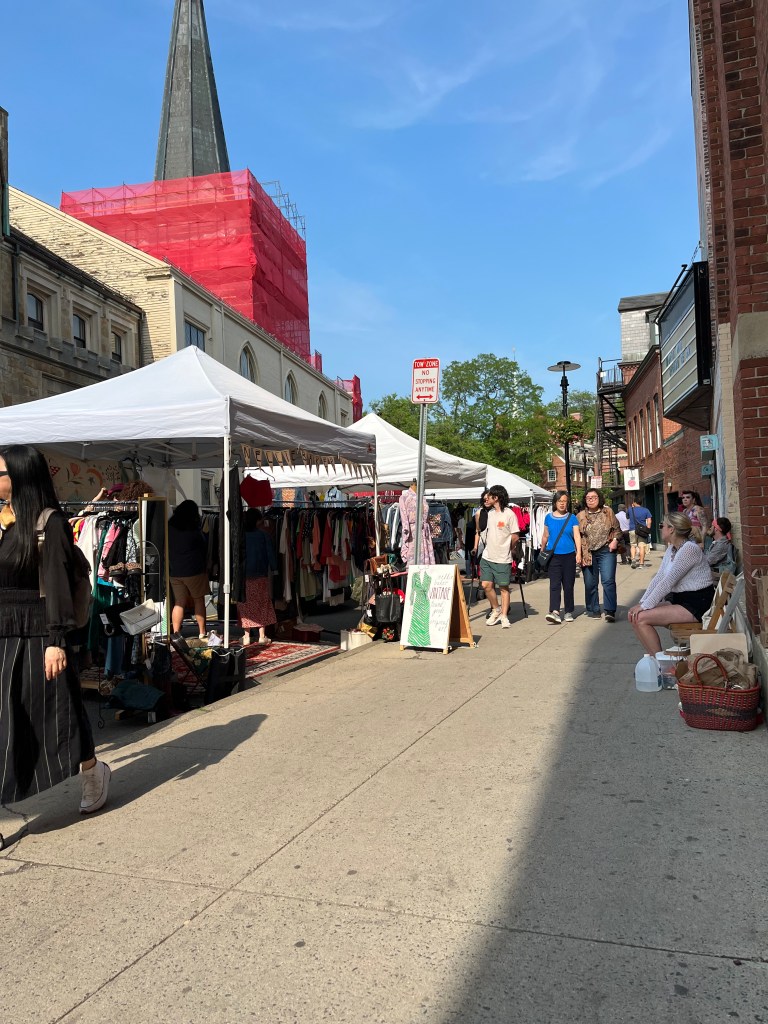
Let’s think about ways to be more intentional and interactive in our shopping experiences. Welcome the attention. Get re-familiarized with the pleasant, albeit simple cordialities of the small business model. Wait for a real person to check out your items. Support small, local businesses that employ real, live people.
 Project Attic
Leave a comment