
Let’s face it. We have an overconsumption problem. We have an attention span problem. Gracious. We’ve got problems. Some call them issues. Let’s delve into a few of these “issues” and problematize them real good.
Planned obsolescence is very lucrative as a business model. Make things that look slick and work like a charm until they don’t. In, say, a week or two, or a month, maybe a year tops. Guaranteed you’re back at the big box stores buying another thing – be it a pleather jacket (oh so sustainable ‘vegan’ made of petroleum, we’ll address this later) or a toaster oven or a blender or… you get the picture. It’s gonna be broke. And so will your pocketbook if you keep it up. Started with light bulbs. You can watch the documentary. I’ll spare you the fine details, but the gist is that some old dude made an electric light bulb that lasted…just…too…long. The corporate guys said, “Hey Dude,” we can’t sell light bulbs if you make them to last a century. We’ll be dead before they quit. So let’s make them flimsier, more fragile, less lasting. Sell more. (And by 1998, we’ll offer a great subscription service where you don’t even have to think about replacement, the lightbulb will very smartly tell you that it needs to be replaced.)
So all your lovely megalomaniacs and money grubbers have put together a model you can’t resist. New!New!New! (This is as old as the introduction of the $2 bill – namely the Industrial Movement…1860s and counting.) But truly the concept of the “new” met its heyday before the First World War and peaked sometime before our 1929 world-wide crash. Before we could actually shut down an entire stock market via AI. Why is this part of a lowly secondhand market post? Listen a while…
Nothing is new. Under the Vergina Sun. The concept of “newness” takes a raging hold again in the post-modern era. Why wait? We can mass produce garments from petroleum-based, synthetic fibers like super fast; AI can replicate patterns from really good to not so good pictures. The fast fashion industry has blossomed with the micro-trends in our super-fast paced, ADD era. Companies can massively print 3D garments to satisfy demand brought about by our dwindling ability to sustain a thought. Today we’re in the middle of the access “yes” access “no” model. Companies can scan a runway photo and deliver a nearly perfect version of the original but replicated in inferior fabrics.
How is this related to a lightbulb? Planned obsolescence? Do you remember a time when cotton jersey-knit was heavy in weight? And then it became “tissue-thin” to be fashionable? A few washes and the shirt begins to disintegrate. A shiny, new pristine sweater looks like yesterday’s garbage after a few washes—pilly and holey. This is the same planned obsolescence—you have to buy more to replace the old which isn’t more than a few months old. But the garments are relatively cheap, so no one really complains. But whatever happened to the capsule wardrobe that contained some staples, your essential garments — such as the quintessential little black dress — that rotate and can be accessorized or layered into different outfits? Whatever happened to style?
Today, we find landfills full of this synthetic, overconsumption of fast fashion. And you think that donating it to your local charity shop keeps it out of the landfill? The shops, like landfills, are filled with cheap polyester crap that doesn’t sell and gets baled and resold to distributors, some overseas, or “ragged out” and sent to the landfill anyway. Many countries have started to refuse U.S. garment waste, so our overconsumption is really becoming a much larger environmental issue for our country than previously understood.
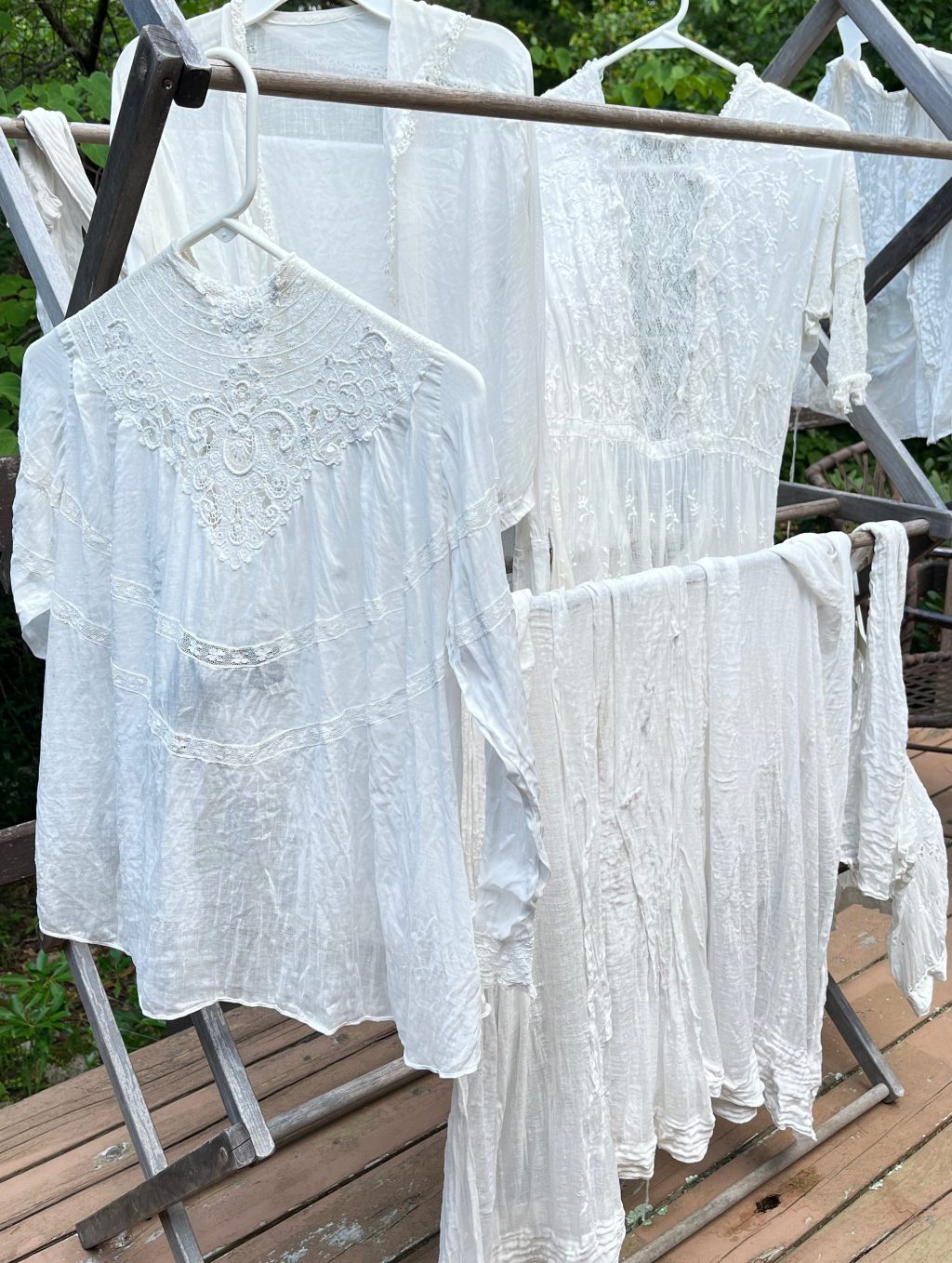
In all seriousness, you don’t want to buy this. You don’t want to contribute to the short life cycle of cheap goods that hide the true payload of their progenitor. Think wars, forced slavery, serfdom, and child labor. Whose fingers work the machines that sew your seams? Think climate. Whose water hydrates the fields to grow cheap cotton for the massive demand for cheap denim jeans? It’s a dark, dark world that affords the purveyance of cheap garments. Buying secondhand doesn’t get around the issue either. Having an informed understanding of fabric quality, country of origin, stylish design, and historical garments brings you into the world of vintage. In the words of my vintage-slinging friend, “‘Why is this so pricey?’ Because it survived 75 years, sweetheart.” In reality, the vintage garment that survived 75 years will likely survive a few more. Don’t sweat it. Just buy the good stuff.
New Year’s Resolution:
- Buy Vintage
- Support Local Business

 Project Attic
Leave a comment